
The Tel Dan Stele

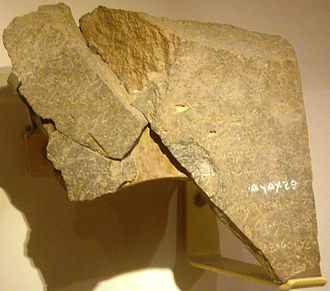
The first stele (A) was discovered at the site of Tall Dan in 1993, in the far north of the modern State of Israel at the foot of Mount Hermon near the Lebanese border.
The other two fragments (B1) and (B2) were found a little further north of the first site.
A total of three stelae were discovered. They appear to be interlocking.
This is evidence of a 9th-century BC dynasty dating back to David.
The inscription on the first stele (A) reads: “And I killed the king of the house of David.”
The inscription on stele (A) cannot be later than the end of the 9th century, or around 840 BC. On all the stelae, we find the biblical description of the events recounted in 2 Kings 8:25 and 9:28.
André Lemaire created a line-by-line translation by combining the two fragments. The parts that cannot be read because they are missing or too altered by erosion are represented by […..]:
1′. […………………]…….[……………………………..] and cut/cut […………………….]
2′. [………] my father went to [………………..]fighting with/against Ab[….]
3′. And my father succumbed; he went to his [fathers]. And the king of I[s-]
4′. rael entered the land of my father[. And] Hadad made me king.
5′. And Hadad went before me[, and] I left from ………..[……………..]
6′. of my kings. And I killed two mighty kings, who had under their command two thousand chariots
7′. and two thousand horsemen. [I killed Joram son of [Ahab]
8′. king of Israel, and I killed [Ahaz]yahu son of [Joram king]
9′. of the House of David. And I placed [……………………………………………….]
10′. their land …[……………………………………………………………………………]
11′. another …[………………………………………………………………. and Jehu reigned]
12′. over Is[rael………………………………………………………………………..]
13′. siege over [……………………………………………………]
Possible Biblical Parallels
The inscriptions could coincide with certain events recorded in the Hebrew Bible:
- 2 Kings 8:7-15 recounts how, before Hazael became king of Aram, his predecessor fell ill and died in his bed:
- Elisha went to Damascus. Ben-hadad, king of Syria, was ill; and word was sent to him, saying, “The man of God has come here.”
- The king said to Hazael, “Take a present with you and go to meet the man of God and inquire of the Lord by him, saying, ‘Shall I recover from this disease?'”
- Hazael went to meet Elisha, taking with him a present of all the best things in Damascus, forty camels’ loads. When he arrived, he stood before him and said, “Your son Ben-hadad, king of Syria, has sent me to you to say, ‘Shall I recover from this disease?'”
10 Elisha answered him, “Go, tell him, ‘You will recover!’ But the Lord has shown me that he will die.”
11 The man of God looked intently at Hazael and gazed at him for a long time, then he wept.
12 Hazael said, “Why is my lord weeping?” Elisha replied, “Because I know the evil you will do to the Israelites; you will set fire to their fortified cities, kill their young men with the sword, crush their infants, and rip open the bellies of their pregnant women.”
13 Hazael said, “But what is your servant, this dog, that he will do such great things?” And Elisha said, “The Lord has revealed to me that you shall be king of Syria.” - Hazael left Elisha and returned to his master, who said to him, “What did Elisha say to you?” And he answered, “He said to me, ‘You shall recover.'”
- The next day, Hazael took a blanket, dipped it in water, and spread it over the king’s face, and he died. And Hazael reigned in his place.
- 2 Kings 8:28 and 9:15-16 report that after being wounded fighting at Ramoth-Gilead, Jehoram of Israel was “deposed” at Jezrael:
8:28. He went with Jehoram, son of Ahab, to battle against Hazael, king of Syria, at Ramoth-Gilead. And the Syrians wounded Jehoram.
9:15. But King Jehoram had returned to Jezreel to be healed of the wounds the Syrians had inflicted on him while he was fighting against Hazael, king of Syria. Jehu said, “If it is your will, no one will escape from the city to go and tell Jezreel.”
9:16 So Jehu mounted his chariot and set out for Jezreel, for Jehoram was lying there, and Ahaziah, king of Judah, had come down to visit him.
Rendsburg adds that “One might even venture to say that the Assyrian expression Bit Humri (“house of Omri”), to designate the kingdom of Israel, came to the Assyrian scribes via the Arameans.” (Omri was a king of Israel whose reign extended from 873 BC to 844 BC, and who founded a dynasty that ruled Israel for four reigns. During these reigns, Israel came into military conflict with Assyria. Assyrian records mention King Ahab, son of Omri, as “Ahab the Israelite,” who fought against Assyria.)
