
11Q Paleo Leviticus
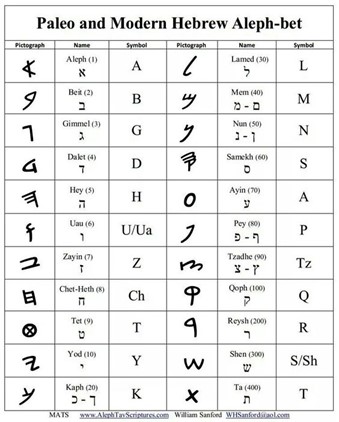
Paleo-Hebrew Leviticus Scroll, known also as 11QpaleoLev, is an ancient text preserved in one of the Qumran group of caves, which provides a rare glimpse of the script used formerly by the Israelites in writing Torah scrolls during pre-exilic history (Before 606 B.C.). The fragmentary remains of the Torah scroll is written in the Paleo-Hebrew script and was found stashed away in cave no. 11 at Qumran, showing a portion of Leviticus. The scroll is thought to have been penned by the scribe between the late 2nd century B.C. to early 1st century B.C., while others place its writing in the 1st century AD.Paleo-Hebrew is an ancient script used by the Israelites to write their Hebrew language. It is derived from the Proto-Sinaitic alphabet, which is the origin of several Semitic writing systems. Paleo-Hebrew was primarily used until the Babylonian exile (6th century BC), at which point it began to be replaced by the square Aramaic script, which became the standard Hebrew script we know today.

Panoramic Photo of the whole Paleo-Leviticus
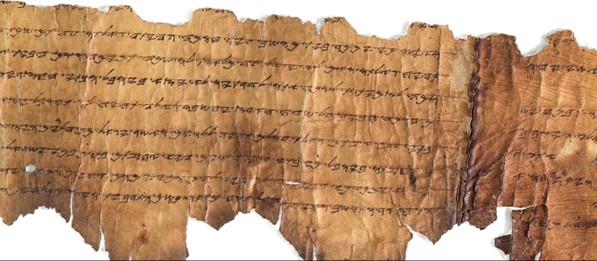
Closer photo showing the Paleo Hebrew writing

Description
The paleo-Hebrew Leviticus Scroll consists of fifteen fragments and one scroll of seven columns, measuring 100.5 centimetres (39.6 in) in length. The scroll is thought to have been originally part of a larger Torah scroll made-up of individual sheets of parchment that were sewn together. The surviving scroll, showing portions of the Book of Leviticus, shows only the bottom portion of two sheets of parchment (ca. one-fifth of its original height), now measuring 10.9 centimetres (4.3 in) in height. The two sheets of parchment are shown sewn together; one containing three columns, and the other four columns, for a total of seven extant columns. The paleo-Hebrew script is written upon horizontal ruled lines, indented in the parchment by a semi-sharp instrument, from which the scribe “hangs” his letters. The rule lines were made mechanically and have a distinctive lighter shade of brown, and are intersected with indented vertical lines at the ends of the margins.
The scroll contains much of Leviticus chapters 22:21–27, 23:22–29, 24:9–14, 25:28–36, 26:17–26, and 27:11–19, with smaller fragments showing portions of chapters 4:24–26, 10:4–7, 11:27–32, 13:3–9, 14:16–21, 18:26–19:3, 20:1–6, etc.
Partial translation of scroll
In the following nine lines, a translation of the paleo-Hebrew Leviticus Scroll is rendered as follows:
Lev. 23:22-29 (contained in the second column). Words written here in brackets are based on the scrolls reconstruction, as they are missing in the original manuscript.
- (22)[…edges of your field, or] gather [the gleanings of your harvest; you shall leave them for the poor and the stranger; I am the LORD your God.
- your God.
- (23)The LORD spoke to Moses saying: (24)Speak to the Israelite people thus: In the seventh month
- on the first day of the month, you shall observe complete rest, a sacred occasion commemorated with load blasts.
- (25)You shall not work at your occupations; and you shall bring an offering by fire to the LORD.
- (26)The LORD spoke to Moses saying: (27)Mark, the tenth day of this seventh month is the Day
- of Atonement. It shall be a sacred occasion for you: you shall practice self-denial, and you shall bring an offering
- by fire to the LORD; (28)you shall do no work throughout that day. For
- [it is a Day of Atonement on which] expiation is made on your behalf before the LORD your God. (29)Indeed, any person who…