
The heel bone and nail
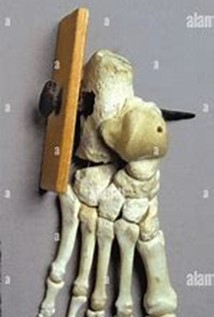
Proof of crucifixion: The heel bone and nail from the ossuary of Yehohanan, discovered in Jerusalem in 1968.
In 1968, several tombs dating back to the time of Jesus were discovered in Jerusalem. In one of them, an ossuary, or stone chest, was found, with a nail passing through the ankle bone of the buried man. This is extremely important, as it is the only known archaeological discovery of a crucified person. Experts were able to deduce several interesting facts from this.


First, the nail was not driven through the front of the foot, as is often depicted in paintings of Jesus, but rather through the ankle, directly through the bone. This meant that a separate nail was driven into each foot, with the feet attached to either side of the cross, rather than in front. Archaeologists were also surprised to find fragments of wood on both sides of the ankle bone. This led to the conclusion that the nail was first placed in a wooden joint before being driven through the foot and the cross. The joint was intended to prevent the victim, or family members, from attempting to remove the body from the cross to avoid the excruciating pain of crucifixion.

Suspended on the cross, the victim was forced to stand on these nails through their ankles and alternately support their weight with their outstretched, nailed hands. This process was all the more painful as the flesh torn from the back by the scourging rubbed against the cross while the victim supported themselves by their hands and alternately stood on their feet. They could live for several days on the cross before dying, and therefore, Jesus’ death after only a few hours was highly unusual. It is believed that the victims died of asphyxiation caused by the exhaustion of the position on the cross.
The fact that Jesus was willing to die on the cross for us in such an atrocious way teaches us of His incredible love. He could have been put to death by stoning or in several other ways, but instead, He chose to be crucified. He submitted to the most heinous and feared forms of death so that He could understand and rescue His people. None of us can claim that Jesus cannot understand our sorrows, our anguish, and our suffering, for he endured it all. Truly, as Isaiah so prophetically declared:
“He was wounded for our transgressions, he was bruised for our iniquities; the chastisement of our peace was upon him, and with his stripes we are healed.”